It is 7:30 pm.
Dinner is done. The TV is on. And you look at the clock and remember — there is a test tomorrow.
You call out:
"David! Bring your English book. Time to read."
Suddenly, David needs water. Then he needs to use the toilet. Then he remembers his pencil is not sharpened. Then, somehow, the same child who was running around the house five minutes ago becomes very, very tired.
You feel it rising — that familiar mixture of frustration and fear. Is something wrong with this child? Why does he make everything so difficult?
But what if something else is actually happening?
What if your child is not being difficult — they are simply drowning, and they have no words to tell you?
I want to share four simple ways with you today. Not theories. Not long lectures. Just honest, practical truths that can change how you see your child's struggle — and what you can do about it.
Your Child May Not Hate Reading.
They May Hate How Reading Makes Them Feel.
Picture this. Every time your child opens their book, they struggle with the words. They read one paragraph and forget what it was about. You ask a question and they go blank. You correct them. You correct them again. And somewhere at school, they have watched classmates understand things they cannot.
After a while, the book no longer represents a lesson. It represents failure. It represents correction. It represents "Why don't you know this?"
And the child's brain begins looking for an escape — the water, the toilet, the pencil.
"Mummy, what happens next?"
That is the sentence you want to hear. It tells you your child's love of stories is alive. But they can only say it when reading does not feel like punishment.
Start with something they genuinely enjoy — football, animals, cars, comics, a funny story. Anything that reconnects them to the idea that reading can actually be pleasant. Once the feeling around books changes, the learning has room to follow.
Your Child Is Not Forgetting on Purpose.
Their Brain Simply Cannot Hold It All.
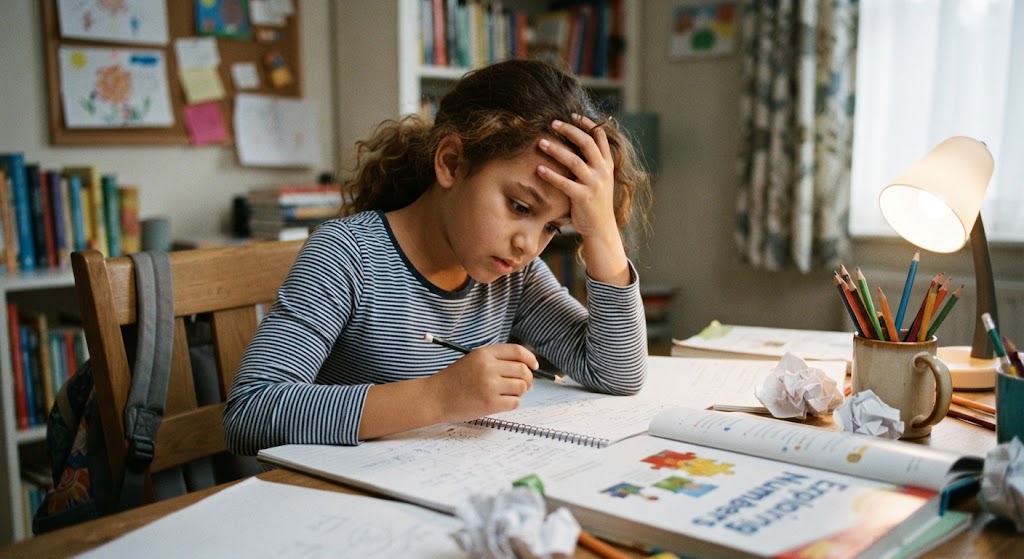
You gave your child a simple instruction:
"Go upstairs, get your blue sweater, brush your teeth, and bring your math notebook."
Ten minutes later, he returns holding a toy truck. No sweater. Teeth unbrushed. Notebook still on the desk.
Or you spent an hour studying a chapter together the night before. But the next morning, when you ask — they look at you as if they have never heard it in their lives.
We assume forgetfulness equals carelessness. We assume they are not listening, not trying, not interested. But in most cases, that is not what is happening.
Working memory — the brain's mental scratchpad — has very strict limits. When a child is stressed, anxious, tired, or given too many instructions at once, their working memory can overload and drop information like a crashed computer. And the brain does not store what it does not truly understand. If a child is reading a paragraph where half the words feel foreign, all their mental energy is spent just decoding the language. There is nothing left to remember.
They weren't choosing to forget. Their brain never filed it in the first place.
What to do instead:
- Break lessons into small, bite-sized pieces instead of long sittings.
- Use a simple checklist or routine chart to reduce the load on their working memory.
- Instead of asking "Do you understand?" — ask them to explain what they just read in their own words. That one habit can make a big difference to how much they retain.
What Your Child Eats Directly Affects
What Their Brain Can Do.

Imagine buying a brand-new high-performance car, then filling the tank with dirty water and sugary syrup. You wouldn't expect the engine to run. Yet we often expect a child's brain — the most energy-demanding organ in the body — to concentrate, retain information and stay calm after a breakfast of white bread and a glass of sugary drink.
The brain uses roughly 20% of the body's energy. For a growing child, the demand is even higher. What they eat can affect:
- Focus and attention — High-sugar snacks cause rapid spikes followed by sharp crashes. That "laziness" or restlessness in the middle of homework may simply be a blood sugar crash.
- Memory and recall — Omega-3 fatty acids (found in fish, eggs, nuts and seeds) help build strong brain cell membranes that support communication between brain cells.
- Mood and motivation — Brain chemicals like dopamine and serotonin, which influence your child's willingness to try, are built from nutrients in food.
Simple changes that help:
- Replace afternoon biscuits and juice with fruit slices, boiled eggs or groundnuts to keep focus steady through homework.
- Make sure they drink water — even mild dehydration can reduce attention and memory.
- Swap white bread breakfasts for eggs, beans, akara, moimoi or oats where possible. Many parents notice the difference in morning focus quickly.
Every Child Has a Natural Learning Style.
Fighting It Is Why Nothing Is Working.

Here is something most parents — and many teachers — have never been told.
Each child has a natural learning style: a way their brain is most comfortable receiving, processing and storing new information. If you keep teaching them against that style, they can struggle far more than they need to — not because they are dull, but because the lesson is not reaching them in a form they can easily take in.
There are four major learning styles:
Visual
Learns by seeing. Diagrams, charts, pictures, colours and demonstrations. Textbooks alone may not work for this child.
Auditory
Learns by hearing. Discussions, explanations, songs and reading aloud. This child needs to hear things.
Reading / Writing
Learns through text. Reading quietly, taking notes, making lists and rewriting. This child can get lost in long verbal explanations.
Kinaesthetic
Learns by doing. Hands-on activities, movement, experiments and real-life practice. Sitting still is genuinely hard for this child.
Most children have one style that comes more naturally, and there are simple activities that help them build the others too. Once you notice your child's strongest style and begin working with it — not against it — homework can feel completely different.
This is one of the core things I cover inside The Confident Learner System: how to identify your child's learning style and the daily activities that match it.
"When we change how we see our children's struggles — moving away from frustration and toward understanding, proper support, good nutrition, and a teaching method that fits who they are — we stop fighting against them. We start building with them."
Your child is not broken. They are not lazy. They are not dull. They are a child who has not yet been given the right key.
You can have that key. And I want to hand it to you directly.


