What Other Parents
Won't Tell You…
They're using simple psychological techniques at home to help their children read better and perform smarter in school.
Dear father — I know you're tired and worried about your child's academic performance.
But help has arrived for you.
Dear Father,
This letter is for you and you alone. I know you're tired and worried about your child's academic performance, but help has arrived for you.
You are not weak for feeling this way. You are carrying something heavy because you care. You are worried because your child's future feels like your responsibility alone.
"Let me tell you about a man named Emeka…"
His story may sound too familiar. It may feel like someone has been watching your life.
Emeka was not absent. He was not uninvolved. He was not the kind of father who came home and switched off. He was a hardworking man raising his son the best way he knew how, and still watching things fall apart.
He carried the pressure of being the provider, the protector, and now the teacher — all at once.
Every evening after a long day at work, Emeka came home, changed quickly, and sat with his son Tobe to go through the day's lessons. He did not hand that responsibility to his wife. He took it on himself.
He did this even when his body was exhausted. Even when his mind had already given everything at work. Even on days he had nothing left — he still showed up.
He needed his income. He needed to keep things stable. He needed to be the man his family depended on. Failing at this was not something he allowed himself to consider.
A father does not quit. So he kept going, even when he didn't know what he was doing.
A Child Who Was Bright — But Only at Home
This was the part that confused him the most. This was the part that kept him up at night.
Tobe was eight years old, and at home, he was sharp and full of energy.
His father saw the intelligence clearly. He knew what his son was capable of.
He could name every player in the Premier League, recall statistics, mimic commentary, and hold long conversations about football tactics with his father without hesitation.
His focus amazed Emeka. His passion gave him hope.
He remembered game results from months ago. He asked intelligent questions. Nothing about Tobe at home suggested a child who could not learn.
Nothing prepared him for what school would say.
But school told a different story.
And that story embarrassed him. And then it broke him.
In class, Tobe went blank. Lessons his father had drilled into him the night before vanished completely. He could not answer basic questions. He could not recall what he had just been taught.
It felt like pouring water into a leaking bucket, no matter how much effort went in.
His report cards came home filled with comments Emeka read in silence: Needs improvement. Poor recall. Not performing at expected level.
He read them again and again, looking for an explanation that wasn't there.
Each report made him angrier. Not at his son — at himself.
Each comment made him question whether he was doing enough as a father.
After work, no matter how drained he was, Emeka sat with Tobe to revise. He was firm. He was direct. He believed that discipline and repetition would solve the problem.
Because that was what his own father had taught him. Work hard. Push through. Results will come.
He explained things clearly. When Tobe didn't understand, he explained louder.
He refused to accept that his son couldn't get it.
When Tobe still struggled, the frustration rose. His voice hardened. The table was hit more than once.
He never wanted to intimidate his son. But he didn't know what else to do.
After those sessions, Tobe went to bed quiet and withdrawn. Emeka sat alone in the sitting room, staring at nothing.
A silence that said everything he could not say out loud.
He loved his son more than anything. But something was not working, and he could not figure out what.
And for a man who fixes things — not being able to fix this felt like a particular kind of failure.
The Day That Broke His Composure
This was the day everything he had been holding in finally cracked.
One evening, Tobe came home from school and handed his father a maths test without saying a word. He had scored 4 out of 20.
His voice was barely above a whisper when he asked, "Daddy, am I dull?"
That question hit him somewhere words cannot reach.
His classmates had been calling him dull. They laughed when he got answers wrong. He had started refusing to raise his hand in class.
His son was not just falling behind. He was beginning to believe he was worthless.
Emeka told him no. He pulled his son close and told him he was intelligent, that school was not the measure of a man, that things would change.
He became strong for his son in that moment. Because that is what fathers do.
But after Tobe went to bed, Emeka sat outside on his own and stared into the dark for a long time.
Men do not always cry. But they carry things. And that night, the weight was very heavy.
He was frustrated. He was confused. He felt like he had been doing everything right — and getting it completely wrong.
He didn't know who to ask. He didn't want anyone to know he was struggling.
He had tried everything he could think of.
Everything a determined, involved father would try.
He hired a private tutor. When the grades didn't improve, he hired another. Then a third — this one more expensive than the first two combined.
Each attempt felt like hope. Each failure felt like proof that something was seriously wrong.
Money was not the issue. He was willing to spend whatever it took. But spending more had produced nothing.
He sacrificed without hesitation. And still came up empty.
The worry followed Emeka to work!
It followed him into every meeting, every conversation, every quiet moment.
He became distracted and short-tempered at the office. Colleagues noticed. His manager pulled him aside and asked if everything was alright.
He said yes. Men always say yes.
But one day, a performance review came back with a warning that his output had declined and that the company expected more.
That warning shook him to the core.
His son's struggle was now threatening the very thing he worked so hard to protect — his ability to provide for his family.
He felt trapped between fatherhood and survival. Both were slipping.
Then His Breakthrough Came
This was the moment everything began to change.
His breakthrough came the day he finally opened up to an old friend named Chidi over the phone — a former teacher who now ran a learning consultancy. For the first time, Emeka said the truth out loud: the grades, the tutors, the tension at home, the fear that his son was giving up on himself.
The truth came out. And it was a relief just to say it.
Chidi listened, and then said something that stopped Emeka completely: Tobe didn't need more teaching. He needed a better way to learn.
Those words landed differently from anything he had heard before.
Chidi explained practical methods based on how children's brains actually process and retain information — not how adults assume they should.
Methods that worked with the child's natural patterns, not against them.
Trying Again — But This Time Differently
This time, he tried with understanding instead of force.
Emeka decided to try again, but differently this time.
He chose patience over pressure. Strategy over repetition.
He reduced the intensity. Sessions became shorter and more structured. Learning used visual cues, simple activities, and spaced repetition in small, manageable amounts.
Studying stopped feeling like a confrontation.
He stopped pushing for long revision sessions and focused on daily consistency instead.
And slowly, the atmosphere at home began to shift.
See what fathers are saying about this
Fathers just like you — tired, worried, and determined — have used these methods to change their child's story.
I kept thinking I just needed to be harder on him. More discipline. More pressure. This book showed me I was solving the wrong problem entirely. Within 6 weeks, his teacher called to ask what had changed. I didn't know what to say.
My son had started calling himself dull. That broke something in me. Two months after following this book, he came home with 17 out of 20 in science and held the paper up like a trophy. That was the best day I've had in years.
As a father, I don't usually read things like this. But I was desperate. What I didn't expect was how practical it is. No theory. Just clear steps that actually work. My son is now 3rd in his class and he wants to study every evening.
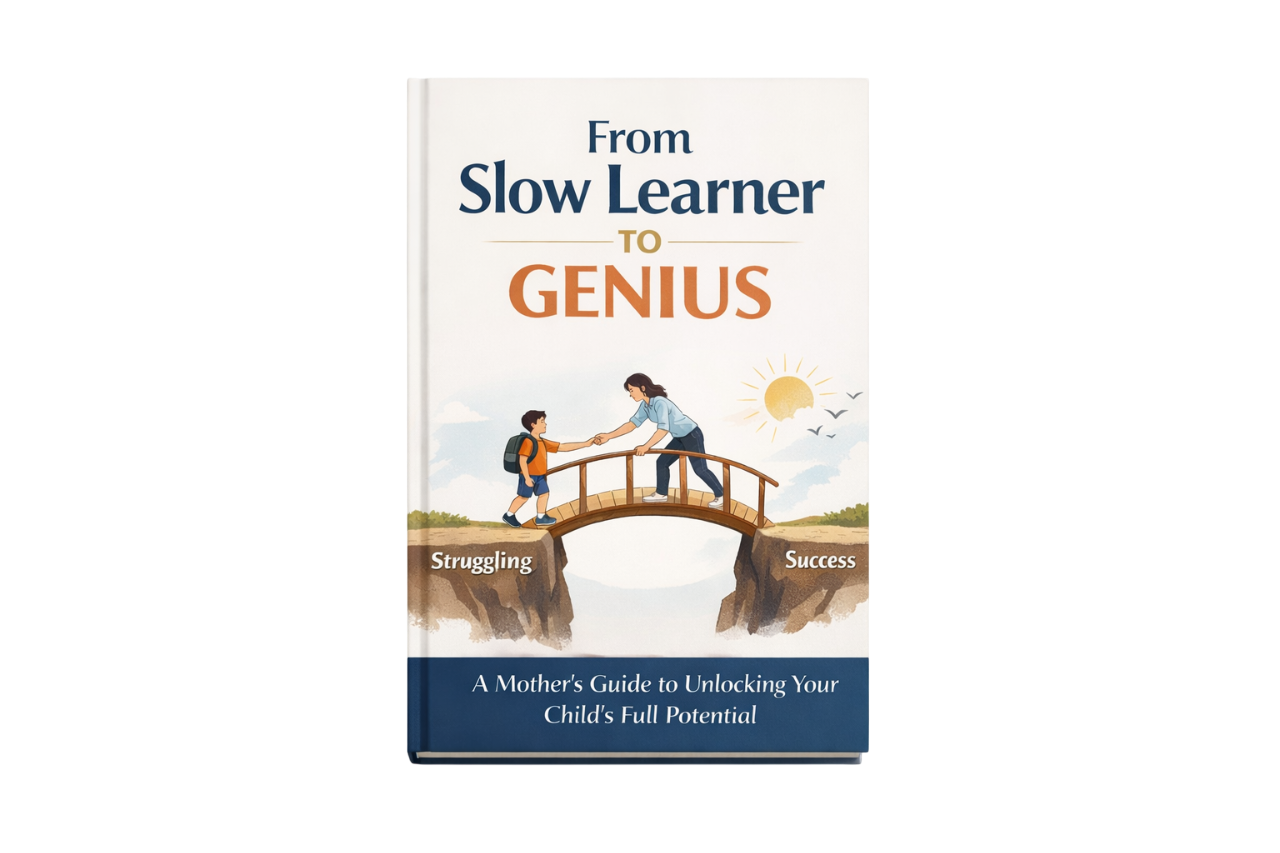
From Slow Learner to Genius
was written for fathers like you
For fathers who are working hard, providing quietly, and doing everything possible — while still feeling stuck. This is not about forcing children, blaming yourself, or turning your home into a classroom.
Understand how your child's brain works
Learn why bright children forget lessons — and what's really happening when they go blank in class.
A simple system that fits real life
Short lessons, visual methods, gentle repetition. No long study marathons. No extra equipment needed.
Build memory, not just knowledge
Help learning enter your child's mind without resistance and build the memory structure they need to succeed.
For children aged 6 to 10
The stage where struggles can still be fully corrected and confidence rebuilt from the ground up.
Move into clarity, not overwhelm
Know exactly what to do and why it works — replacing confusion and fear with confidence and calm.
Go at your own pace
You don't have to rush or feel pressured. Simply reading this book and applying its ideas can begin to change everything.
⚠️ This offer expires in:
Once this timer hits zero, the bonuses may be removed.
For a limited time, I'm also including five special bonuses
at no extra cost
These bonuses were created to give you everything you need — not just the book, but daily guidance, practical tools, and the exact words to say when your child feels like giving up.
The Learning Style Discovery Guide
What it does: Helps you quickly identify how your child learns best — visual, auditory, hands-on, or mixed.
Why it matters: Once you know this, you stop guessing, stop wasting time, and stop blaming yourself.
The 7-Day Calm Homework Routine
What it does: A simple daily structure that turns homework time from shouting and tears into calm cooperation.
Why it matters: Most learning problems are not intelligence problems — they are routine problems.
The Memory-Building Guide for Forgetful Children
What it does: Shows you how to help your child remember what they learn instead of forgetting it the next day.
Why it matters: Forgetting is what destroys confidence in children and hope in parents.
What to Say When Your Child Feels "Dull" or Discouraged
What it does: Gives you the exact words to say when your child feels broken, ashamed, or hopeless.
Why it matters: Words can either heal or destroy a child's belief in themselves.
Daily Learning Prompts for Parents
What it does: Simple daily instructions and tasks you can use with your child — no thinking, no confusion.
Why it matters: It feels like having a guide holding your hand every day.
You should get it now and start using it today
One simple investment. Calmer evenings. A more confident child. A sense of relief you may not have felt in a long time.
From Slow Learner to Genius
The complete step-by-step guide for fathers of children aged 6–10
One-time payment • Instant download • No subscription
- Full digital book — read on any phone, tablet, or computer
- Step-by-step memory and learning methods
- Practical daily routines that fit into your busy life
- Proven techniques to rebuild confidence and end exam fear
- Written for children aged 6 to 10
- Continuous support from me on WhatsApp, where I'll be guiding you daily through all the things you need to do to help your child become a genius
- 30-day money-back guarantee — no questions asked
🛡️ 30-Day Money-Back Guarantee. Zero risk.
Our 30-Day "See the Change or
Get Your Money Back" Promise
We are so confident this book will help your child that we back it with a full 30-day money-back guarantee. Read it. Apply the methods. If you don't start seeing a real difference in your child's learning — just send us a message and we will refund you completely. No arguments. No conditions.
Your child is waiting for
you to find this.
With the right approach, your child — your own child who is struggling right now — can improve dramatically. You do not have to accept confusion, poor results, or constant worry as your normal. You can move into clarity, confidence, and calm.
📖 Get the Book — Start TodayInstant digital access • 30-day guarantee • For children aged 6–10